

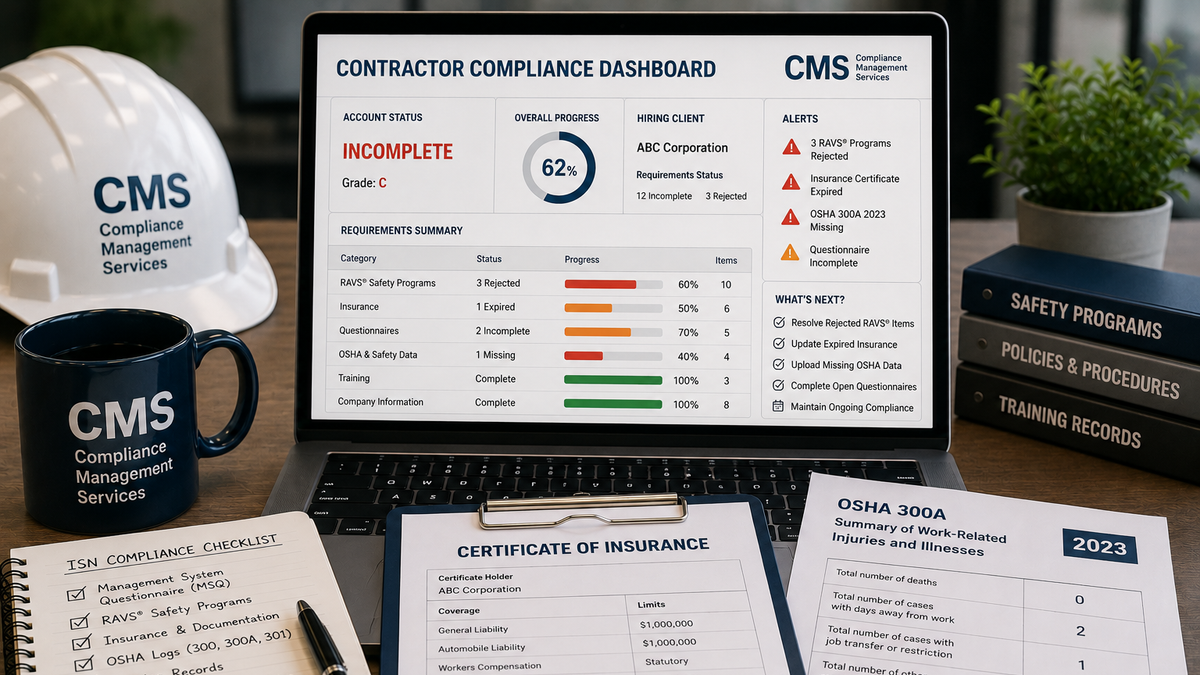
Achieving ISN compliance is a major milestone for contractors looking to win lucrative corporate contracts. Many capital-intensive industries—like oil and gas, construction, and manufacturing—require ISN membership before you can even bid on a project.
However, navigating the complex ISNetworld® platform can feel overwhelming.
This comprehensive guide breaks down exactly what ISN compliance means, what hiring clients look for, and how you can achieve a passing grade without the stress.
What is ISN Compliance?
ISN compliance means your company has successfully met the safety, insurance, and regulatory benchmarks set by a specific hiring client through the ISNetworld® platform.
Think of ISNetworld® as a digital clearinghouse. Instead of a contractor sending safety manuals and insurance certificates to ten different clients, you upload them to ISN once. Hiring clients then log in to verify that you meet their corporate standards.
The Core Requirements for ISN Compliance
To achieve a compliant status, your company must submit data across several key areas. The platform evaluates your business using four primary components:
1. Management System Questionnaire (MSQ)
The MSQ is a massive, detailed questionnaire covering your company’s background, safety history, and operational details. It can feature hundreds of questions tailored to your industry and the specific requirements of your hiring clients.
2. Review and Verification Services (RAVS®)
RAVS® is the trickiest part of the process. ISN safety professionals manually review your company’s written safety programs to ensure they comply with both federal regulations (like OSHA, EPA, or DOT) and specific client mandates. If your written programs miss even a single required clause, they will be rejected.
3. Insurance and Documentation
You must have your insurance agent upload your Certificates of Insurance (COI) directly to the platform. ISN verifies that your coverage limits, worker’s compensation policies, and waiver of subrogation language exactly match your client's requirements.
You will also need to submit:
- Three years of OSHA 300 and 300A logs.
- EMR (Experience Modification Rate) letters from your insurance carrier.
- Employee training records.
4. Safety Performance Metrics
The platform automatically tracks your safety data to calculate your TRIR (Total Recordable Incident Rate) and DART (Days Away, Restricted, or Transferred) rate. Clients look for low incident rates that prove your company prioritizes a safe workplace.
Understanding the ISN Grading System
ISN does not issue a universal "pass" or "fail" grade. Instead, the platform uses a dynamic grading scale—typically A, B, C, or F—that is completely customized by each hiring client.
- Client-Specific: You could have an "A" grade with Client X, but a "C" grade with Client Y because Client Y has stricter insurance requirements.
- Real-Time Changes: Grades are dynamic. If an insurance certificate expires or a client adds a new RAVS® requirement, your grade can drop instantly, potentially locking you out of job sites.
The Benefits of Becoming ISN Compliant
While the process requires an investment of time and money, the return on investment is substantial:
- Open Doors to Major Contracts: For many enterprise clients, ISN compliance is non-negotiable. Being compliant places you on their preferred vendor list.
- Reduced Administrative Burden: Instead of filling out unique prequalification forms for every bid, you maintain one centralized profile.
- Enhanced Safety Culture: Building compliant RAVS® programs inherently makes your business safer, reducing workplace injuries and lowering your insurance premiums over time.
3 Tips to Maintain Your Compliant Status
- Assign a Dedicated Admin: Do not treat ISN as a set-it-and-forget-it tool. Assign a team member to log in weekly to check for new client requirements or expiring documents.
- Submit Quarterly Updates Early: ISN requires quarterly updates for OSHA data and man-hours. Submit these as soon as the quarter ends to avoid automatic grade drops.
- Keep Your Insurance Agent in the Loop: Send your client's exact insurance requirements to your agent before your policy renews so they can draft a compliant COI on the first try.
Frequently Asked Questions (FAQ)
How much does ISN membership cost?
ISN charges an initial setup fee and an annual subscription rate. The price is based on a sliding scale according to your company's employee count and industry risk level.
How long does it take to get ISN compliant?
For a small company with ready documentation, it can take 2 to 4 weeks. For larger companies needing custom-written safety programs, the process can take several months.
Can I fix a failing ISN grade?
Yes. If your grade drops due to a rejected safety program or missing document, you can upload corrected files immediately. Once ISN reviews and approves the updates, your grade will automatically adjust.
Disclaimer: ISNetworld® and RAVS® are registered trademarks of ISN Software Corporation. This guide is an independent educational resource and is not affiliated with or endorsed by ISN.